Business Process Improvement, Document Design, Financial Printing, How-to Guides, Letter Printing and Mailing, Print and Mail Services
Statement Design Best Practices: How to Get More Value from Transactional Customer Documents


What Are Transactional Customer Documents?
Transactional customer documents include monthly statements, bills, invoices, compliance letters, and marketing mailers. These are the documents your customers receive regularly, and each one is a direct line of communication to the people who drive your revenue. Most companies treat them as a necessary operational expense. The smart ones treat them as a marketing channel.
With over 45 years of experience in print and mail outsourcing, FSSI has seen what effective document design looks like across banking, healthcare, credit unions, insurance, and financial services. This checklist is based on that experience.
How Do I Know If My Customer Documents Need a Redesign?
Start by looking at your documents the way your customers do. Be honest. View each page as if you’re seeing it for the first time. Ask yourself: Is the layout clear? Is the most important information easy to find? Does the design reflect your current brand?
If the answer to any of these is no, the document is costing you engagement and potentially revenue.
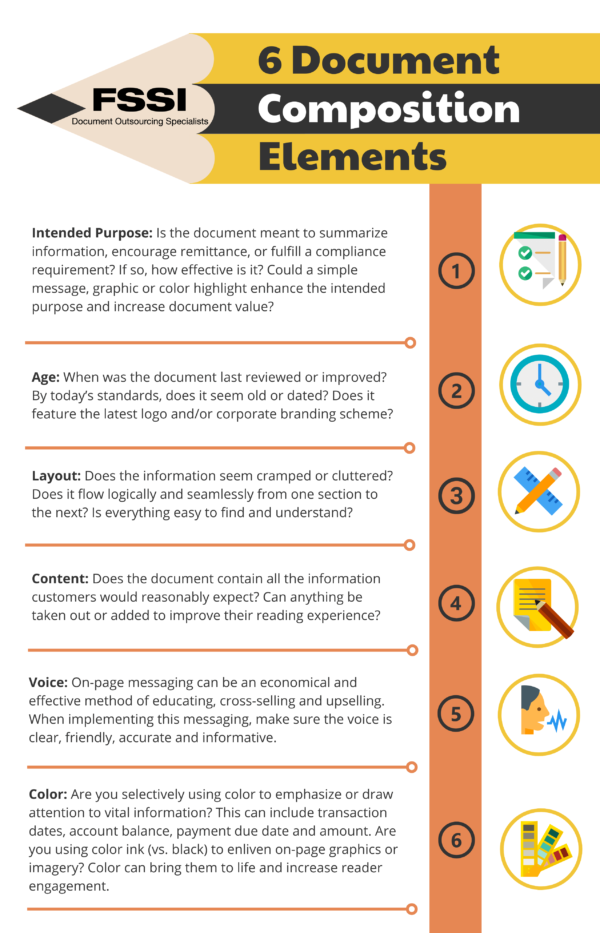
6 Core Elements of Effective Statement Design
Before jumping into specific layout tips, it helps to evaluate your documents against six foundational elements. Each one has a direct impact on whether your customers read, understand, and act on what you send them.
- Intended Purpose Is the document accomplishing what it was designed to do? Whether it is driving payment remittance, summarizing account activity, or fulfilling a compliance requirement, every design decision should support that goal.
- Age When was the document last updated? Outdated layouts and old logos signal neglect. A dated design erodes trust, especially with younger customers.
- Layout Does the information flow logically from section to section? Is there enough visual breathing room, or does it feel cluttered and hard to scan?
- Content Does it include everything a customer would reasonably expect to find? Is there anything redundant that should be cut?
- Color Are you using color strategically to highlight due dates, balances, and key actions? Or is everything printing in black and white?
- Voice If your document includes on-page messaging, is the tone clear, accurate, and friendly? On-page copy is one of the most cost-effective tools for cross-selling and customer education.
Statement Design Best Practices: A Document Layout Checklist
These five principles are the foundation of high-performing transactional document design. Apply them across all your customer-facing communications, including statements, bills, invoices, and direct mail.
Use White Space Intentionally
White space is not wasted space. It improves readability, helps customers retain information, and reduces visual overwhelm. Do not pack every corner of a document just because the space is available.
Eliminate Redundancy
Every inch of a document is valuable. Repeating the same message in multiple places dilutes impact and eats up real estate that could be used for cross-sell messages, promotions, or calls to action.
Keep the Messaging Simple
Remove duplicate fields and redundant text. The simpler your core message, the more clearly it registers. Simplicity also opens up space for targeted marketing messages, coupons, and announcements.
Maintain Brand Consistency
Your statement should look like it belongs to the same brand as your website, your emails, and your app. Consistent design builds familiarity and trust across every touchpoint.
Choose Readable Fonts
Font choice matters more than most companies realize. Decorative or overly stylized fonts reduce legibility, especially for older customers or those reading on small screens.
What Are the Benefits of Well-Designed Customer Statements?
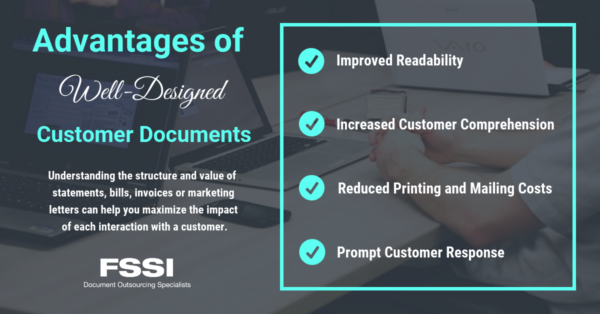
A well-designed document does four things that a poorly designed one cannot:
- Gets read instead of discarded
- Gets understood on the first pass
- Helps customers process and act on information
- Drives response to calls to action
Monthly mailings cost real money. Poor design means that money is largely wasted. Effective statement design ensures you are getting a return on every document you send.
How Does Clear Communication Improve Document Performance?
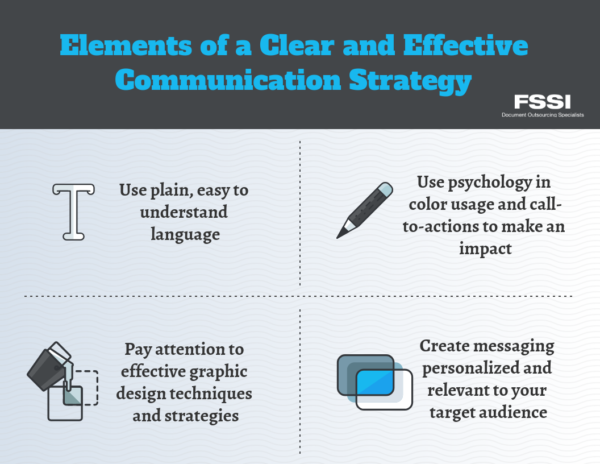
Clear communication is not just about plain language. It is a combination of several disciplines working together.
- Plain language writing
- Visual psychology and color theory
- Graphic design and layout
- Usability and information hierarchy
- Personalization based on customer context
When these elements work together, even a routine billing statement becomes an opportunity to strengthen the customer relationship. A few small changes to layout, color, and copy can improve response rates, increase ROI, and reduce inbound support calls when customers can actually find what they need.
How Can Transactional Mail Double as a Marketing Channel?
Transactional mail has a significant advantage over standalone marketing mail: customers actually open it. That makes it valuable real estate for marketing messages.
FSSI clients have used tools like variable data printing, Direct Mail 2.0 multichannel integration, eStatements, and SMS to turn routine statements into multi-channel touchpoints. Combining transactional and marketing strategies in a single document reduces cost and increases the frequency of meaningful customer contact.
Does Color Really Make a Difference in Statement Design?
Yes, significantly. Human attention is drawn to color, and in a world saturated with information, color is one of the fastest ways to direct the eye to what matters most.
FSSI’s color specialists add variable color to black-and-white statements to highlight critical data points like billing due dates, account balances, and payment amounts. When customers can immediately find the information they are looking for, they take action faster. That speed translates directly into better payment rates, fewer missed due dates, and fewer calls to customer service.
Our in-house design team—including graphic designers, content writers, programmers, and color experts—works with banks, credit unions, auto finance companies, insurance providers, and other financial services organizations.
Get a Free Document Design Review from FSSI
If you are not sure whether your current documents are performing as well as they could, FSSI offers objective, no-cost document reviews. Our in-house team of graphic designers, writers, programmers, and color experts will assess your layout, color use, white space management, and copy, and show you specific opportunities for improvement.
We also maintain a before-and-after sample archive from clients across credit unions, banks, auto finance, healthcare, and insurance. Contact an FSSI Document Design Specialist at 714.436.3300 or request samples online to see what a redesign can do for your documents.
