Auto Finance Customer Communications: Driving Servicing Efficiency with Print and Mail


Borrowers swipe away push notifications. They delete unread emails. They forget portal logins.
When an auto loan statement lands in a physical mailbox, it gets opened. Industry data from Keypoint Intelligence shows that 67% of consumers want their statements delivered through both digital and physical channels. Research from the Association of National Advertisers indicates that 42% of consumers place greater trust in institutions that communicate via physical mail alongside digital channels.
Vehicle financing involves multi-year commitments and significant monthly payments. Relying entirely on digital delivery leads to missed payment windows, higher 30-day delinquencies and expensive customer care outreach.
A hybrid communication model pairs fast digital notifications with reliable paper statements. This dual approach keeps accounts current and maintains consistent contact across the loan lifecycle.
Servicing Challenges Facing Automotive Lenders
Managing borrower communications in-house ties up capital and exposes lenders to operational liabilities.
- Strict Regulatory Oversight: Auto lenders operate under CFPB scrutiny, the Gramm-Leach-Bliley Act (GLBA) and state-level consumer lending statutes. Missing statutory postmark deadlines on adverse action notices or right-to-cure letters creates immediate legal risk.
- Capital Equipment Expenses: Maintaining high-speed printers, folder-inserters and postal meters drains operational budgets. Equipment depreciates quickly. Maintenance contracts run high.
- Data Privacy Risks: A single envelope stuffing error exposes non-public personal information (NPI). Mismatched statements trigger privacy investigations, brand damage and regulatory fines.
- Rising Postal Overhead: Mailing statements without high-density sorting means paying maximum retail postal rates on every piece.
Outsourcing production shifts equipment upkeep, compliance tracking and postal logistics to a specialized production environment.

Critical Auto Finance Documents Suitable for Outsourcing
Auto servicing requires precision timing across variable data formats.
| Document Category | Document Use | Operational Requirement |
| Monthly Billing Statements | Recurring payment reminders detailing principal, interest and loan balances. | Dynamic transaction tables, variable remittance stubs and full-color targeted messaging. |
| Payment Coupon Books | Multi-page payment vouchers for subprime or non-checking borrowers. | Perforated MICR coupon printing with custom bound covers and verified binding. |
| Lease-End & Maturity Packages | Turn-in instructions, vehicle inspection rules and equity buyout offers. | Multi-page variable booklets triggered 90, 60 and 30 days prior to lease expiration. |
| Regulatory & Default Notices | Right-to-cure letters, repossession disclosures and adverse action letters. | Timestamped audit logs, 24-hour turnaround windows and piece-level delivery verification. |
| Annual Tax Statements | 1098 and year-end interest statements. | Automated TIN masking, IRS schema compliance and high-volume January postal injection. |
Inline Optical Verification Prevents Co-Mingling
Thick auto loan packets and variable-page statements increase the risk of sheets slipping into the wrong envelope. Hand collation cannot scale. Standard machine counters miss double feeds.
Our production facilities rely on dynamic 2D Data Matrix barcodes printed on every page. High-speed optical cameras scan each sheet on the inserter track:
- Sequence Matching: The system checks that page numbers run consecutively.
- Page Count Integrity: The cameras verify that a four-page statement contains all four sheets before feeding an envelope.
- Account Matching: The system confirms that every page belongs to the identical borrower account.
If a misfeed occurs, the inserter track halts instantly. The rejected piece gets isolated, logged and queued for audit. Borrower data stays protected. Statements never mix.
Maximizing Postal Savings on Recurring Loan Mailings
Postage represents the highest single expense in any recurring auto finance mail program. Sending bills at standard transactional rates wastes budget.
We route customer files through automated logistics engines:
- CASS and NCOALink Address Hygiene: Address lists run against USPS change-of-address databases before production starts. Invalid addresses get flagged or updated, eliminating wasted printing and return mail cycles.
- High-Density Mail Commingling: Your statement volume merges into combined mail pools containing millions of pieces. This process sorts mail down to five-digit zip codes and carrier routes, capturing the highest available USPS automation discounts.
- Automated Return Mail Processing: Undeliverable mail gets scanned by barcode, digitizing the return notice and updating your servicing database without manual data entry.
Learn more about our postal optimization and commingling services.
Connecting Physical Mail to Digital Servicing Portals
Paper statements should support your digital payment channels.
- Dynamic QR Codes: Print individualized QR codes directly on billing stubs. Borrowers scan the page with a mobile phone and route straight to an authenticated quick-pay screen, skipping manual login friction.
- Unified ePresentment: Ingest one data feed to generate paper mail and electronic PDFs simultaneously. Borrowers see identical statement layouts whether logging into your mobile app or opening an envelope.
- Automated Print Failovers: If an electronic billing notice bounces or remains unread after a set period, the system automatically prints and mails a physical notice. Statutory compliance stays intact.
Explore our electronic bill presentment solutions for financial services.

Redundant Facilities and Enterprise Security
Auto finance records require audited operational controls. FSSI processes borrower communications within secure production centers audited annually under SOC 2 + HITRUST CSF certified standards.
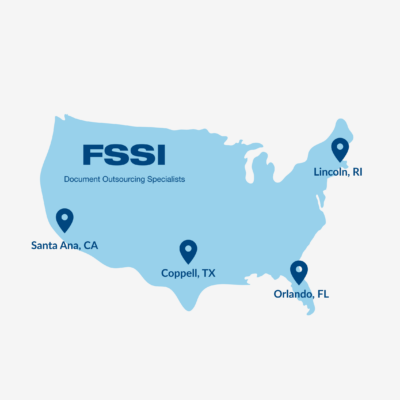
Facilities in California, Texas, Rhode Island and Florida provide built-in geographic redundancy. If severe weather or a localized outage impacts one plant, print and mail workflows route immediately to a secondary facility. Drop dates are protected. Delivery schedules never slip.
Frequently Asked Questions
How does FSSI integrate with our automotive loan servicing software?
We ingest data files directly from core loan servicing engines through encrypted SFTP connections. Our composition platform accepts flat files, line data, CSV, XML and print streams without requiring major internal development work from your IT team.
How do camera verification systems prevent borrower data leaks?
Optical cameras scan 2D barcodes printed on each page of every statement. The system audits account numbers, sequences and page counts in real time. If a sheet is out of order or an extra page feeds, the machine halts automatically to isolate the affected record.
Can we place targeted promotional offers on monthly auto statements?
Yes. Our variable data composition tools use unused statement space to present individualized messages. You can promote lease buyout programs, GAP insurance, warranty extensions or refinancing options based on specific borrower loan-to-value (LTV) ratios and payment histories.
How quickly can urgent default notices or cure letters be mailed?
Time-sensitive compliance documents route through expedited print queues. We produce and inject critical collections letters and statutory notices into the postal stream very quickly upon of file receipt, providing complete timestamped audit logs for legal validation.
Modernize Your Auto Loan Communications
Eliminate manual inserting, protect borrower data and reduce monthly postage overhead. Contact FSSI today at 714.436.3300 to speak with an auto finance document specialist, or request a customized print and mail audit.
