
HITRUST Print and Mail Outsourcing: What Compliance Teams Need to Know

Print, mail and digital document outsourcing for critical customer communications is beneficial for expanding your organization’s production capacity while cutting overhead and postage costs. Choosing the right outsourcing partner is especially important when files contain sensitive information, including account balances, Protected Health Information (PHI), tax forms or payment data.
Data vulnerabilities do not disappear once a file leaves your internal network. Risk persists while data sits on external servers, runs through automated inserters, moves across physical production floors and enters the postal stream.
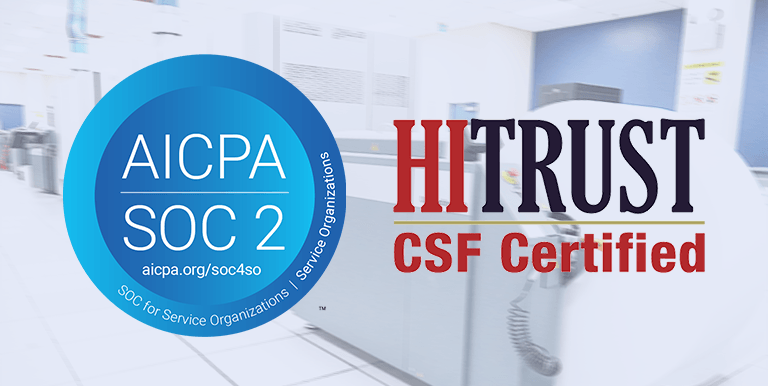
Choosing a partner with validated HITRUST CSF and SOC 2 Type II credentials ensures external assessors actively verify security controls and that data is processed in a highly secure environment.
What Is HITRUST CSF in Print and Mail Operations?
The HITRUST Common Security Framework (CSF) is a certifiable, risk-based security framework. It maps multiple compliance standards—including HIPAA, NIST, ISO 27001 and PCI DSS—into a single matrix of prescriptive controls.
In transactional print and mail environments, HITRUST CSF verifies that physical and digital safeguards protect client data across the entire production cycle:
- Data Transmission and Ingestion: Enforcing TLS encryption protocols, automated PGP file decryption and restricted directory permissions.
- Production Floor Security: Limiting physical facility access via biometric locks, badge logs and 24/7 CCTV monitoring over production lines.
- White-Paper Factory Integrity: Using automated camera verification systems and optical barcode scanning to track every printed sheet, preventing multi-page statement mix-ups.
- Data Sanitization and Purging: Automatically scrub temporary spool files and digital print images from print servers on defined retention schedules.
SOC 2 vs. HITRUST CSF: How Do They Differ?
Enterprise procurement teams often weigh SOC 2 against HITRUST CSF. They serve distinct, complementary functions during vendor due diligence.
| Metric | SOC 2 Type II | HITRUST CSF |
| Primary Focus | Operating effectiveness of an organization’s specific internal controls over a set review window (typically 6–12 months). | Adherence to a unified, prescriptive framework mapped across federal regulations and global standards. |
| Benchmark Standard | AICPA Trust Services Criteria (Security, Availability, Processing Integrity, Confidentiality, Privacy). | Harmonized baseline integrating HIPAA, NIST SP 800-53, ISO 27001 and PCI DSS. |
| Assessment Model | Attestation report written by an independent CPA firm detailing testing procedures and findings. | Rigorous scoring and formal certification issued directly by the HITRUST Alliance following third-party assessor audits. |
| Buyer Takeaway | Proof that the provider’s documented policies functioned without failure over the past year. | Proof that the vendor meets a standardized, high-water mark for cybersecurity and privacy controls. |
Pairing both certifications gives compliance, infosec and legal teams verifiable evidence that data handling procedures are both documented and independently tested.

Frequently Asked Questions
Does hiring a HITRUST-certified print vendor make my organization HIPAA compliant?
No. HITRUST certification demonstrates that a vendor maintains mature administrative, technical and physical controls for PHI. However, covered entities and business associates remain legally responsible for their own compliance. You still need executed Business Associate Agreements (BAAs), defined data retention rules and ongoing vendor governance.
How does a secure print partner prevent mail mix-ups and privacy breaches?
Leading secure mail operations rely on end-to-end piece-level tracking. High-speed inserters read 2D data matrix barcodes printed on each page to confirm page sequence, page counts and envelope matching in real time. If a sheet misfeeds or jams, the inserter stops automatically, logs the discrepancy and prevents misdirected mail pieces.
What physical security controls should a direct mail facility maintain?
A secure facility requires multi-factor perimeter control, visitor badging protocols, zoned badge access to production floors, 90-day CCTV video retention, clean-desk policies and locked disposal bins for shredded waste stock.
Evaluating Your Print and Mail Partner
When evaluating vendors for recurring billing, tax documents or patient communications, ask for specific proof:
- Current Certifications: Request the active HITRUST Letter of Certification and the latest SOC 2 Type II audit report.
- Business Continuity: Verify dual-facility redundancies and real-world SLA recovery windows for power grid or network outages.
- Data Segregation: Confirm how client databases are isolated in transit and at rest.
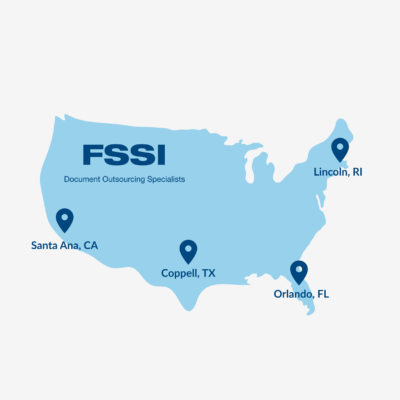
FSSI delivers over 45 years of secure document production for financial services, healthcare, insurance, utilities and other highly regulated industries. Backed by SOC 2 + HITRUST CSF compliance, FSSI embeds security directly into high-volume print and digital delivery operations.
To review compliance documentation or discuss upcoming communication programs, contact an FSSI specialist at 714.436.3300 or schedule an assessment online.