

Business Process Improvement, Compliance Communications, Customer Experience and Engagement
Customer Communications Management (CCM): Architecture & Workflows


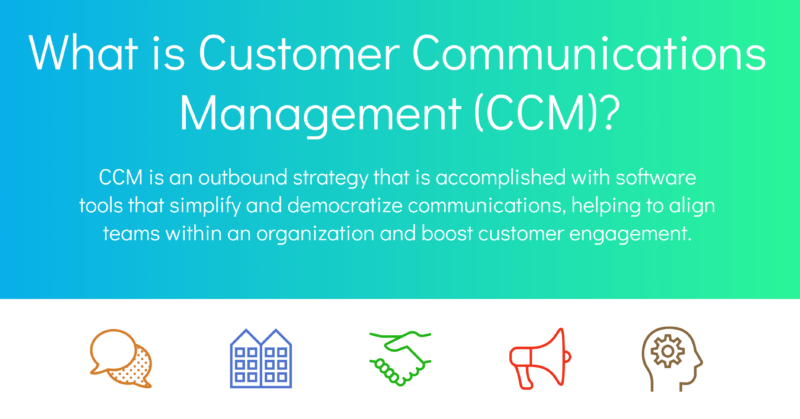
Customer Communications Management (CCM) is the enterprise practice of designing, producing, and distributing critical customer communications across physical and digital channels.
Unlike marketing messaging, CCM governs essential, highly regulated correspondence: monthly billing statements, explanations of benefits (EOBs), policy renewal packets, tax forms, and adverse action notices. A mature CCM framework takes raw data directly from core business systems, formats it into clear, compliant documents, and delivers it according to individual customer preferences.
CCM vs. CRM vs. Marketing Automation: What Is the Difference?
Organizations often ask why they need a dedicated CCM platform if they already run platforms like Salesforce or HubSpot.
CRMs manage relationships. Marketing automation drives sales pipeline. CCM acts as the system of record for critical operational documents where errors carry legal liabilities and compliance fines.
Each tool serves a fundamentally different purpose within enterprise operations:
| Capability | CRM | Marketing Automation | Customer Communications Management |
| Core Function | Records sales interactions and account histories | Orchestrates promotional campaigns and tracks clicks | Generates and delivers legally binding, critical documents |
| Primary Data Source | Manual user entry and lead forms | Web activity, form fills, and email opens | Core transactional databases (billing, ERP, claims engines) |
| Output Type | Direct correspondence, task logs, and notes | HTML promotional emails, landing pages, SMS blasts | High-volume print streams (AFP/PDF), eStatements, tax files |
| Data Sensitivity | General business contact information | Marketing lead data | Strict PII, financial account records, PHI |
| Compliance Control | Minimal audit requirements | CAN-SPAM and opt-out management | Stringent governance: GLBA, HIPAA, NCUA, CFPB |
| Postal Integration | None | None | CASS/NCOA presorting, commingling, USPS IMb tracking |
The End-to-End CCM Workflow: From Raw Data to Multi-Channel Delivery
An enterprise CCM engine operates as an automated bridge between complex core databases and the end consumer.
[Core Systems: ERP, Core Banking, Billing]
                     │
                     ▼
          [Secure SFTP Data Feed]
     (XML, JSON, Flat Files, Print Streams)
                     │
                     ▼
          [CCM Processing Engine]
  ┌──────────────────┴──────────────────┐
  │ • Data Validation & Composition     │
  │ • Dynamic Variable Logic Mapping    │
  │ • Regulatory Disclosure Injection   │
  └──────────────────┬──────────────────┘
                     │
         [Multi-Channel Distribution]
        ┌────────────┴────────────┐
        ▼                         ▼
 [Physical Production]    [Digital Presentment]
  • CASS / NCOA Presort    • SSO Member Portal
  • High-Speed Inkjet      • PDF Archive Storage
  • 2D Barcode Insertion   • SMS / Email Alerts
  • USPS Mail Stream       • Failed Delivery Failover
1. Secure Data Ingestion
The process begins when transactional databases generate routine batch exports. These files arrive via secure, encrypted SFTP pipelines in formats such as flat line-data, CSV, XML, JSON, or legacy print streams (AFP, PostScript).
2. Document Composition and Variable Logic
The composition engine parses incoming records and applies predefined design rules. Rather than using static page layouts, the platform dynamically swaps content blocks based on member data:
- Injecting legally mandated state disclosures based on the recipient’s ZIP code.
- Adding personalized payment plan options for overdue accounts.
- Inserting targeted transpromotional messages directly onto monthly statements.
3. Output Bifurcation
Once compiled, the platform splits documents based on user-managed delivery preferences:
- Digital Presentment: Records convert into indexed, accessible PDFs stored in secure digital archives, accessible via single sign-on (SSO) web and mobile portals.
- Physical Production: Records convert into production print streams carrying automated 2D data matrix barcodes. These barcodes guide automated inserters, verifying page matching and preventing statement co-mingling.
Why Regulated Industries Cannot Rely on Digital-Only Communications
Software vendors often portray CCM as an entirely digital discipline. For regulated entities in banking, healthcare, auto finance, and utilities, pure digital delivery remains an operational impossibility.
Physical print and mail remain vital for several critical reasons:
- Statutory Delivery Mandates: Federal and state regulations frequently require physical paper for legally binding notifications. Cancellation notices, final collection letters, privacy policy updates, and adverse action statements often carry statutory mailing rules that electronic emails cannot legally satisfy.
- Digital Delivery Failures: Emails bounce, spam filters swallow notifications, and portal passwords are forgotten. Robust CCM workflows incorporate automated failover rules. When an electronic billing notification bounces or goes unopened for a specified number of days, the platform automatically generates and mails a physical paper backup.
- Accessibility and Inclusion: A notable portion of consumer bases either lack consistent high-speed internet access or explicitly choose paper records for financial tracking and record-keeping.
In-House Software Licensing vs. Outsourced CCM Managed Services
Organizations approaching a CCM overhaul generally face two deployment models: licensing enterprise software internally or partnering with an outsourced CCM managed service provider.
The In-House Software Model
Licensing platforms like Quadient Inspire or OpenText Exstream requires immense upfront capital. Beyond software licensing and maintenance contracts, the enterprise takes on heavy technical overhead:
- Hiring specialized composition developers and template programmers.
- Buying or leasing high-speed production inkjet printers, inserters, and warehouse square footage.
- Managing constant postal logistics, envelope inventories, and presort audits.
- Carrying full internal liability for hardware downtime during month-end closing windows.
The Outsourced Managed Services Model
Partnering with an established transactional provider converts heavy capital expenditures into a predictable, variable operating cost.
The vendor provides the certified infrastructure, template design team, postal logistics, and secure ePresentment portals. Your technical team simply delivers the raw data feed, while operational dashboards provide complete transparency into real-time document production and postal tracking.
Frequently Asked Questions
What does CCM stand for in business operations?
CCM stands for Customer Communications Management. It refers to the operational systems, software, and workflows used to create, distribute, and store critical, compliance-driven customer correspondence.
What is the primary difference between CCM and CRM?
A CRM tracks sales leads, support tickets, and general customer relationship history. A CCM platform generates and delivers legally binding, data-dense documents like bills, statements, policy forms, and notices across physical and electronic channels.
How does CCM support regulatory compliance?
CCM systems maintain detailed audit trails for every document processed. They enforce consistent inclusion of mandated regulatory disclosures, encrypt personally identifiable information (PII), and use 2D barcode camera verification on physical insertion equipment to guarantee zero co-mingling errors.
Can a CCM platform handle both print mail and digital delivery?
Yes. Modern CCM architectures use a single-source-of-truth approach. The engine ingests one raw data stream, formats the document, and automatically routes the final output to online ePresentment portals, automated email/SMS alerts, or high-speed production print lines based on individual customer preferences.
Modernize Your Critical Communications with FSSI
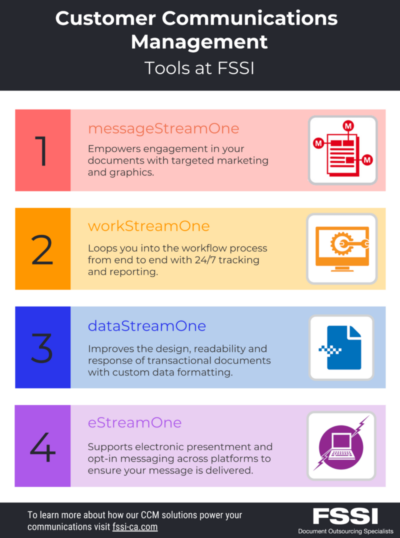
FSSI delivers comprehensive, outsourced Customer Communications Management solutions designed for institutions operating under strict regulatory oversight. Backed by over four decades of transactional print and digital experience, FSSI eliminates the software licensing and equipment overhead of in-house document production.
- Turnkey Multi-Channel Delivery: Combine high-volume transactional print and mail services with secure, hosted electronic bill presentment and eDelivery.
- Audited Security Standards: Maintain total data integrity with SOC 2 Type II and HITRUST CSF certified workflows.
- Document Redesign Expertise: Transform standard bills and notices into clean, easy-to-read retention tools through expert transactional document redesign.
- Real-Time Job Tracking: Track jobs from initial data receipt to final USPS handoff with secure workflow tracking and reporting dashboards.
Ready to streamline your transactional communications and reduce production overhead? Contact FSSI today at 714.436.3300 to schedule a consultation with an enterprise communication specialist, or build a custom capabilities brochure tailored to your organizational needs.
