


Regulatory Compliance, Tax Form Printing and Mailing
Outsourcing Tax Form Processing: 1099, W-2, and 1095 Print and Mail Services


Year-end tax reporting creates an operational crunch that overwhelms internal accounting, HR, and IT teams. Tight IRS deadlines, high document volumes, strict data security mandates, and unforgiving penalties for misdirected mail leave no margin for error.
Managing tax form printing in-house ties up office printers, consumes administrative labor, and exposes organizations to data privacy liabilities.
Outsourcing tax form processing transfers production logistics, IRS schema compliance, and postal optimization to a secure, specialized partner.
2027 IRS Tax Form Deadlines: Recipient Delivery vs. IRS Filing
Meeting IRS postmark deadlines protects your organization from statutory late-filing penalties. Missing recipient mail-out dates can trigger fines ranging from $60 to over $310 per form under IRS Section 6721/6722 rules.
| Tax Form Type | Recipient Postmark Deadline | IRS Paper Filing Deadline | IRS Electronic Filing Deadline |
| 1099-NEC | February 1, 2027 | February 1, 2027 | February 1, 2027 |
| W-2 / W-3 | February 1, 2027 | February 1, 2027 | February 1, 2027 |
| 1099-MISC | February 1, 2027* | March 1, 2027 | March 31, 2027 |
| 1099-INT / DIV / R | February 1, 2027 | March 1, 2027 | March 31, 2027 |
| 1095-B / 1095-C | March 2, 2027 | March 1, 2027 | March 31, 2027 |
| 1098 (Mortgage) | February 1, 2027 | March 1, 2027 | March 31, 2027 |
*Note: When Box 8 or 10 contains reported amounts, the 1099-MISC recipient deadline extends to February 16. (Dates shift to the next business day when standard calendar deadlines fall on weekends).
The 10-Form E-Filing Mandate
The IRS requires organizations filing 10 or more aggregate returns across all information return types (combining W-2s, 1099s, 1095s, and 1098s) to file electronically via the IRS FIRE or IRIS systems. Operating an outsourced print workflow ensures your data is automatically formatted for digital IRS submission while generating physical recipient copies simultaneously.
Supported Tax Documents: Managing Complex Year-End Runs
Handling disparate tax files across multiple departments or business units creates operational friction. Centralizing data mapping into one automated pipeline standardizes variable layouts, logic, and output across critical form families.
1099 Series Production (NEC, MISC, INT, DIV, B, R)
Whether reporting non-employee compensation for independent contractors on Form 1099-NEC or interest income for financial institution account holders on Form 1099-INT, high-speed variable digital printing handles fluctuating volumes with dynamic page scaling. Consolidated 1099 statements merge multiple tax events into a single, clean packet to minimize envelope count and postage spend.

W-2 Wage and Tax Statements
Handling annual W-2 reporting requires pinpoint accuracy across complex earnings data. Prepress data mapping parses multi-state tax withholding lines, local earned income taxes, and pre-tax benefit allocations cleanly into official IRS Copy B, C, and 2 formats. Fast-turn reprint engines enable rapid re-mailing when employees submit updated address records.
Affordable Care Act (ACA) 1095-B and 1095-C Forms
Large employers and health coverage providers must generate 1095-C and 1095-B forms to prove compliant coverage. Beyond federal requirements, production workflows handle state-specific individual mandate reporting for jurisdictions with distinct filing rules, including California, New Jersey, Rhode Island, and Washington, D.C.
1098 Mortgage and Lending Statements
Lending institutions, loan servicers, and universities rely on automated production for 1098 mortgage interest, property tax allocations, and 1098-E/T tuition statements. Layout designs place required borrower account details and interest summaries in clear, easily scannable formats.
Taxpayer Notices and Regulatory Correspondence
Peak tax season often requires supplemental communications alongside standard returns. Workflows accommodate batch audit letters, delinquency notices, annual privacy updates, and formal municipal property tax collection notices under the same secure production umbrella.
Production Security: Protecting High-Risk PII
Tax documentation represents the most sensitive data payload an organization processes: legal names, Social Security Numbers (SSNs), Employer Identification Numbers (EINs), home addresses, and annual earnings. Sending records off-premises requires industrial-grade governance, audited facility controls, and physical verification to prevent data exposure.

- SSN / TIN Masking: Automated layout routines mask the first five digits of taxpayer identification numbers (e.g., ***-**-1234 or XXX-XX-1234) on recipient-facing documents and window envelopes, maintaining IRS privacy standards during transit.
- Audited Facility Controls: Production environments align with SOC 2 + HITRUST CSF frameworks. Strict physical access restrictions, 24/7 facility monitoring, and encrypted data pipelines protect records at rest and in transit.
- 2D Barcode Inserter Cameras: Every individual sheet carries a dynamic 2D Data Matrix code. High-speed optical cameras scan each page on the inserter track, verifying that all pages intended for Recipient A enter Envelope A. The machine halts instantly if a sequence mismatch occurs, eliminating envelope co-mingling errors.
- Piece-Level Audit Logs: Web-based production dashboards record the exact millisecond a file is ingested, validated, imaged, inserted, and released to the United States Postal Service.
Postal Optimization and Return Mail Mitigation
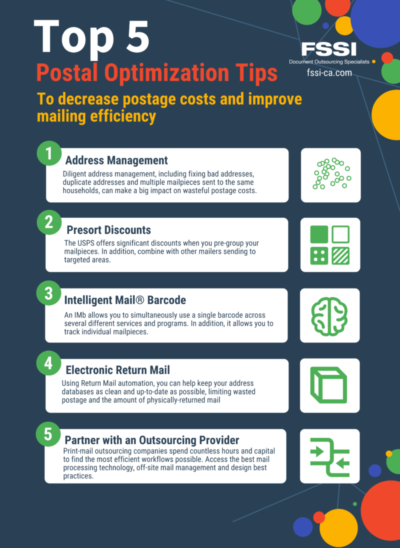
Postage represents the dominant cost in tax season fulfillment. Processing data through automated logistics tools reduces per-piece rates and limits returned mail cycles:
- NCOA and CASS Address Hygiene: Processing records against the National Change of Address (NCOA) database and Coding Accuracy Support System (CASS) verifies postal routes and catches moves before ink hits paper.
- Householding: System logic identifies duplicate recipient records across departments, safely combining multiple forms for the same individual or household into a single outer envelope to cut material and postage expenses.
- Automated Return Mail Handling: Undeliverable tax forms create heavy compliance and administrative burdens. Automated solutions like eReturn Mail track barcodes on returned envelopes, digitize recipient notices, and update core databases automatically to clean up records for future cycles.
Hybrid Delivery: Physical Mail and Secure Digital Tax Portals
Tax workflows must support both traditional paper recipients and digital-first users. Relying on password-protected email attachments creates major cybersecurity risks and high delivery failure rates.
An integrated tax workflow bridges print and online distribution:
- Single Sign-On (SSO) Presentment: Integrate tax PDF access directly within existing mobile banking apps or employee HR portals. Recipients authenticate through established credentials to view, download, and print their official forms.
- Paperless Consent Management: System rules filter consented digital users out of physical print queues, reserving paper stock and postage spend strictly for recipients requiring physical delivery.
- Automated Print Failovers: If a digital tax notification bounces or goes unviewed within required compliance timelines, the workflow automatically generates and routes a physical statement to print production.
Migration Blueprint: Preparing Early for Year-End Runs
Onboarding an outsourced tax fulfillment partner should never be left to December. Establishing data pipelines in late Q3 or early Q4 eliminates year-end fire drills.
- Discovery & Data Ingestion: Review sample data extracts (XML, CSV, flat files, print streams) and envelope stock requirements.
- Template Mapping & Proofing: Format document rules, set dynamic TIN masking parameters, and review layout proofs via secure online PDF portals.
- SFTP Pipeline Setup: Establish automated, PGP-encrypted transfer connections and user permission tiers.
- Test Run Validation: Run masked sample data across physical printing lines to audit fold points, envelope window placement, and inserter 2D camera reads.
- Production & Live Reconciliation: Receive year-end batch files, produce runs within agreed-upon turnarounds, and verify closed-loop piece counts against source intake logs.
Proven Accuracy: Processing High-Volume Municipal Tax Rolls
County tax collectors face strict statutory drop dates, massive property databases, and zero tolerance for misdirected mail. A single batch error creates immediate public scrutiny and compliance liabilities.
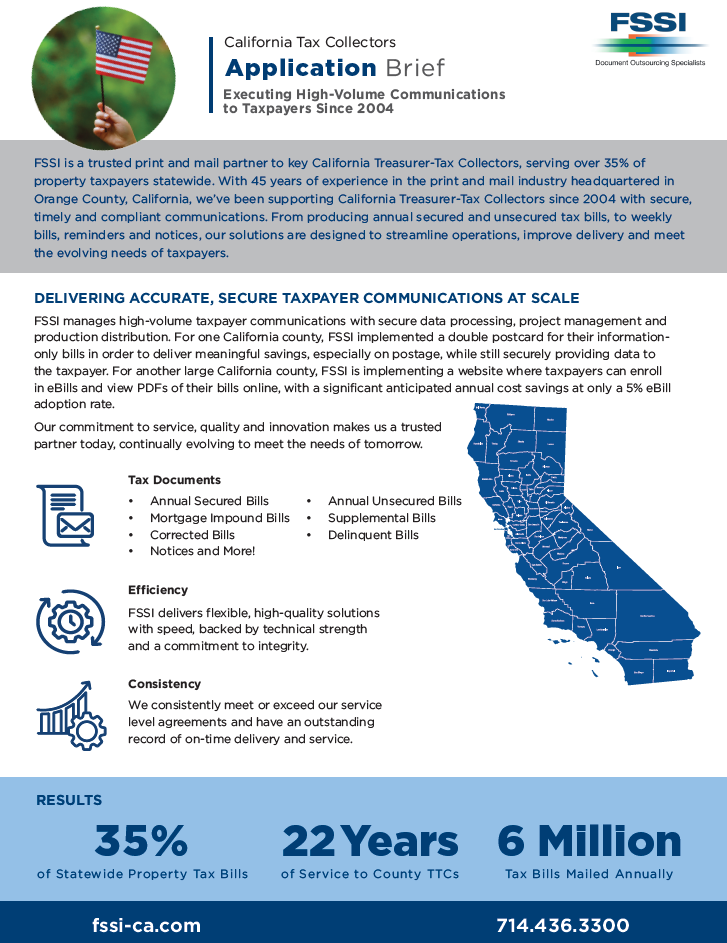
FSSI manages high-volume property tax statements and municipal notices across California counties using automated data hygiene, digital proof approvals, and piece-level inserter cameras. The result: guaranteed postal drop windows, clean closed-loop reconciliation, and complete data privacy.
County Government Case Study: See how California Tax Collectors rely on FSSI to process high-volume tax mailings without operational delays or manual audits.
Read the California Tax Collector Application Brief
Frequently Asked Questions
Can an outsourced print vendor handle electronic IRS filing along with mailing?
Yes. An outsourced transactional communications provider can take your raw data extract, print and mail the required recipient copies, and generate the formatted electronic file for direct transmission to the IRS and SSA via FIRE or IRIS conduits.
How does TIN/SSN truncation work on printed tax forms?
Under IRS guidelines, organizations may truncate an individual payee’s identifying number on paper recipient statements. The system masks the first five digits of the Taxpayer Identification Number (displaying as XXX-XX-1234 or ***-**-1234), protecting recipient privacy in transit.
What data formats are required to submit tax records for outsourcing?
Established providers accept standard data exports directly from leading ERP, core banking, and payroll platforms. Common formats include XML, CSV, flat ASCII line-data, or pre-composed print streams.
What is the lead time needed to onboard tax form outsourcing?
To ensure complete data validation, template proofing, and parallel testing, organizations should begin onboarding in late Q3 or early Q4. This timeline ensures all workflows, portal integrations, and envelope inventories are locked down before January processing windows open.
How is recipient PII protected during high-volume tax form processing?
Tax form data is transferred via encrypted SFTP pipelines and stored in SOC 2 + HITRUST CSF-certified facilities. On the production floor, automated layout rules truncate Social Security Numbers on recipient copies, and optical 2D barcode cameras scan every sheet to prevent mis-matching or co-mingling in envelopes.
FSSI: Your Secure Partner for Tax Form Printing and Mailing
FSSI provides secure, high-volume tax form processing solutions designed for financial institutions, government agencies, healthcare networks, and enterprise employers. Backed by over four decades of transactional print and secure data experience, FSSI eliminates the seasonal operational bottlenecks of year-end reporting.
- Turnkey Form Production: High-speed print, fold, insert, and electronic reporting for 1099, W-2, 1095, and 1098 document runs.
- Audited Compliance Controls: SSAE 18 SOC 2 + HITRUST CSF-certified workflows guaranteeing strict PII confidentiality.
- Automated Camera Verification: Optical inserter scanning confirming envelope matching and page-count accuracy.
- Integrated Electronic Presentment: Secure digital document hosting and eDelivery portals that reduce paper and postage overhead.
- Postal Optimization & Return Mail Handling: CASS address standardization, automated householding, and eReturn Mail tracking to control total program costs.
Ready to streamline your year-end reporting and safeguard taxpayer data? Call FSSI today at 714.436.3300 to speak with a transactional document specialist, or build a custom capabilities brochure tailored to your organizational needs.
