Business Process Improvement, Direct Mail Marketing, How-to Guides, Letter Printing and Mailing, Outsourcing, Print and Mail Services
Print and Mail Outsourcing Services: The Complete Guide

High-volume transactional mail carries zero margin for error. That is why regulated organizations rely on print and mail outsourcing services to handle statements, bills, and critical notices. Aging equipment, rising postal rates, and strict compliance audits leave little room to run an internal print shop efficiently.
Banks, credit unions, healthcare providers, utilities and auto lenders face heavy consequences if a single document fails to reach an account holder on time. Shifting production to dedicated specialists eliminates the burden of leasing inserters, storing envelope inventory, and managing facility overhead.
This guide breaks down the economics of outsourcing, what to expect during document onboarding and how to vet a partner capable of protecting sensitive customer data.
Current Trends in Transactional Print and Mail
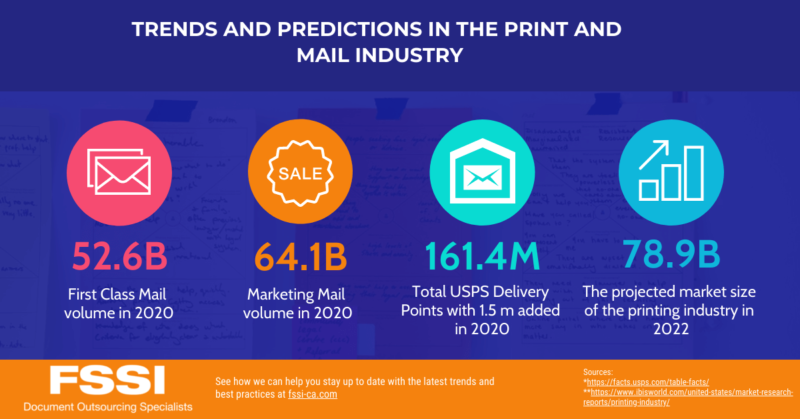
Physical mail remains a cornerstone for critical customer communications. Despite digital adoption, regulatory requirements and consumer habits maintain steady demand for hard-copy records:
- $77+ Billion Market: U.S. commercial printing maintains massive scale, driven largely by regulatory document fulfillment.
- 167 Million Delivery Points: The USPS daily network spans every residential and commercial address nationwide.
- First-Class Transactional Priority: Essential documents—invoices, bank statements, explanation of benefits (EOBs) and cancellation notices—are sent primarily via First-Class Mail.
- Hybrid Multichannel Delivery: Modern operations do not choose between physical and digital. Top-tier providers manage high-volume print and compliant electronic document delivery (eDelivery) simultaneously.
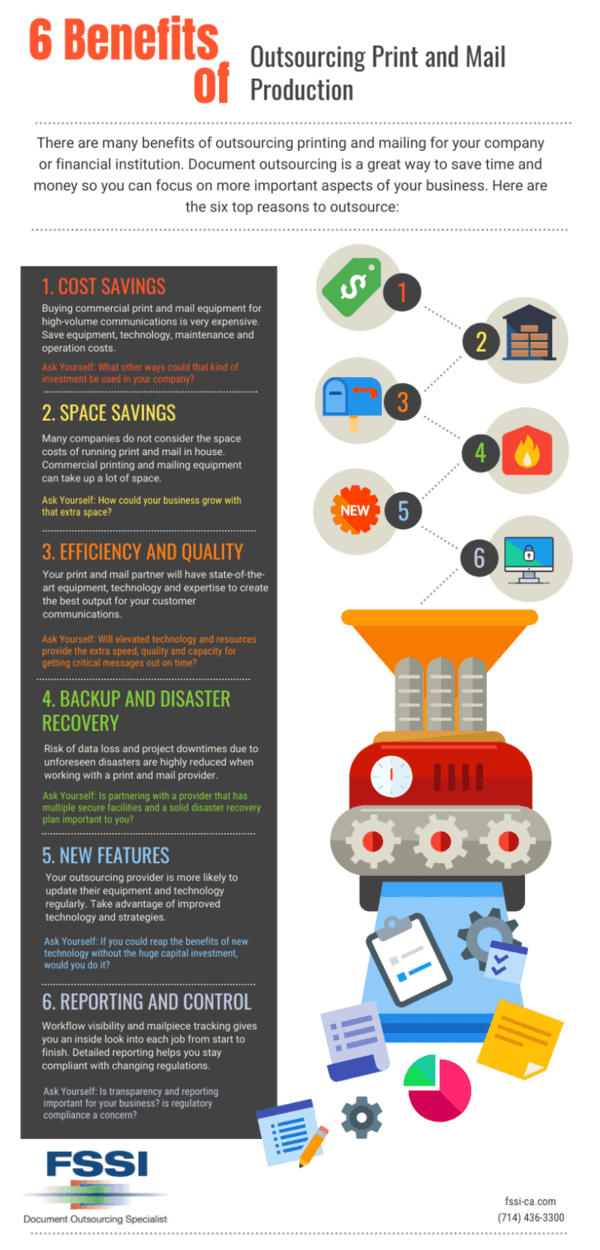
Key Benefits of Outsourcing Print and Mail for Regulated Industries
Moving document production outside your walls solves several capital and operational hurdles at once.
Reduced Overhead and Commercial Postage Discounts
Production printers and high-speed intelligent inserters carry six-figure price tags before adding routine maintenance contracts, parts inventory and skilled machine operators.
Outsourcing providers distribute those capital investments across billions of pages. Because providers presort vast volumes of mail every day, your organization captures commercial bulk postage discounts that no standalone internal print shop can access. The savings on First-Class postage often offset production fees entirely.
Elimination of In-House Print Shop Footprint
High-volume mailing operations devour square footage. Paper rolls, palletized envelope inventory, staging space and finished mail trays tie up valuable floor space. Outsourcing reclaims that footprint for revenue-generating staff and eliminates specialized facility overhead like heavy industrial HVAC and reinforced flooring.
Automated Quality Control and Barcode Verification
Specialized facilities operate with strict inline inspection systems. Optical character recognition (OCR) and 2D barcode cameras scan every page at full production speed. The system verifies that page sequences match, account numbers align, and no two customer statements end up in the same envelope. Errors that trigger costly reprints or regulatory disclosures get flagged before the piece hits a mail tray.
Disaster Recovery and Multi-Facility Redundancy
A single internal print facility represents a single point of failure. A power failure, frozen pipe, or equipment breakdown halts critical billing cycles.
Leading outsourcing providers run multiple geographically distributed production facilities. If severe weather hits one region, your jobs automatically route to an alternate plant without missing mailing deadlines or triggering statutory penalties.
High-Speed Variable Data Printing and Finishing
Document needs change fast. Meeting modern communication standards requires continuous investment in variable data printing, inline perforation, full-color dynamic messaging, and intelligent mail barcodes (IMb). Outsourcing grants access to high-speed inkjet and dynamic finishing equipment without adding heavy assets to your balance sheet.
Real-Time Job Tracking and Mailpiece Reporting
Handing off files does not mean losing control. Modern providers provide secure web portals for end-to-end tracking. Operations teams can monitor file ingestion, review PDF proofs, track production stages and verify when individual mailpieces clear USPS processing centers.
Audit-Ready Compliance and Regulatory Reporting
In banking, insurance, and healthcare, mailing a document is only half the battle. You must prove delivery timelines to auditors and state regulators. Providers log automated production histories down to the individual recipient level, giving compliance teams verified data trails whenever questions arise.
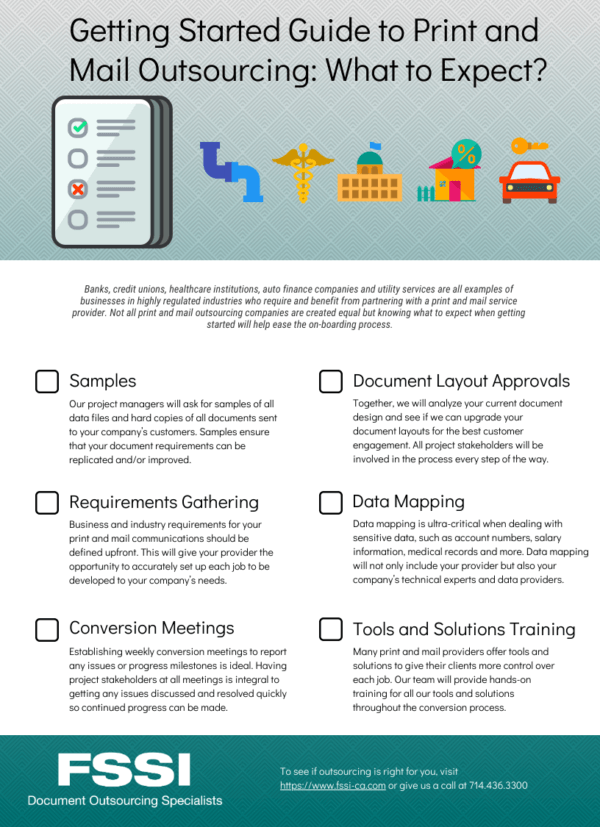
Onboarding: What the Conversion Process Looks Like
Switching print and mail partners requires careful technical alignment. A structured conversion process keeps data secure and eliminates production gaps.
Step 1: Sample Collection and Data Analysis
The provider’s conversion team reviews historical print streams, sample data files and live hard-copy documents. This phase maps out every font, margin, envelope window position and fold requirement.
Step 2: Document Redesign and Template Optimization
Many organizations use a vendor transition to update legacy layouts. Through professional document redesign services, companies clean up cluttered statements, improve readability and add designated marketing or regulatory messaging areas.
Step 3: Business Logic and Compliance Rules Mapping
Every exception rule gets documented:
- Specific insert criteria based on account balance or geographic state.
- Suppression rules for customers enrolled in digital billing.
- Targeted messaging blocks driven by recipient data.
Step 4: Secure Data Mapping and Integration
Data transmission protocols are established over encrypted SFTP or secure APIs. The technical team maps raw customer data fields directly to the document generation engine, paying special attention to sensitive identifiers like account numbers and medical codes.
Step 5: End-to-End Parallel Testing
Live data runs through the new pipeline in parallel with current production. Hard-copy samples are weighed, measured and scanned to verify barcode readability, USPS machinability, and data alignment before signing off on final deployment.
How to Choose a Print and Mail Outsourcing Company
When evaluating vendors for sensitive customer communications, focus on operational fundamentals:
| Evaluation Criteria | What to Look For | Why It Matters |
| Data Security | SOC 2 Type II, HIPAA compliance, HITRUST certification | Confirms physical and logical data safeguards meet federal and institutional standards. |
| Facility Redundancy | Multiple physical production sites with mirrored equipment | Ensures continuous operations during regional disasters or machine failure. |
| Industry Expertise | Direct experience in financial services, utilities, auto lending, or healthcare | Eliminates the learning curve around industry-specific compliance rules and billing cycles. |
| Hybrid Capabilities | Unified print and digital delivery from one platform | Prevents data silos between physical mail and paperless account portals. |
| Tracking Detail | Piece-level USPS tracking through an online portal | Gives your customer service and legal teams immediate proof of dispatch. |
Frequently Asked Questions About Print and Mail Outsourcing
What types of documents are best suited for outsourcing?
High-volume, recurring transactional communications deliver the strongest return on investment. Common applications include monthly bank and credit union statements, utility bills, medical collection notices, explanation of benefits (EOBs), policy renewal packets, tax forms (1099s/W-2s) and collection letters.
How do outsourcing providers ensure customer data security?
Reputable print vendors function as secure data operations. They protect data using end-to-end encryption for files in transit and at rest, maintain role-based network permissions, monitor facilities with 24/7 biometric access controls, and undergo annual third-party audits for SOC 2 + HITRUST CSF and HIPAA compliance.
Can an outsourcing partner manage both print and paperless delivery?
Yes. Modern providers run centralized document composition engines. A single data feed generates compliant physical mail for print-preferring customers and pushes secure PDFs or email/SMS notifications to your web portal for electronic presentment.
Streamline Your Transactional Document Operations
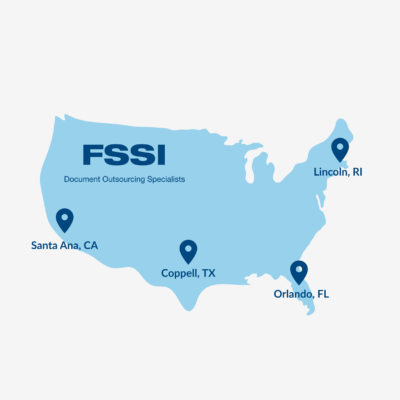
FSSI manages high-volume, compliance-heavy print and digital communications for financial institutions, healthcare networks, insurers and utility providers nationwide. With 45+ years of production experience, multi-site facility redundancy, and strict SOC 2 + HITRUST CSF compliance, we keep your customer communications secure, accurate, and on schedule.
Ready to lower postage overhead and remove equipment bottlenecks? Call 714.436.3300 to speak directly with an outsourcing specialist, or request a technical assessment of your current document workflows.

Sources:
*USPS: https://facts.usps.com/table-facts/
**IbisWorld: https://www.ibisworld.com/united-states/market-research-reports/printing-industry/