Business Process Improvement, Document Design, How-to Guides
Improve the Impact of Transactional Customer Statements


Maximize Customer Statement ROI: Design Best Practices for Financial Institutions
Financial statements aren’t just account summaries. They’re direct marketing channels. Each document is an opportunity to communicate with customers who are already paying attention.
Yet most banks and credit unions treat statements like regulatory obligations, not business opportunities.
After over 45 years of working with financial institutions on transactional document optimization, we’ve identified the design elements that transform routine statements into engagement tools. Here’s how to extract maximum value from every customer touchpoint.
Why Transactional Document Design Matters for Banks
Monthly statements, bills, and invoices reach customers when they’re most engaged with your brand. Whether you handle document production in-house or partner with a print-mail services provider, optimizing these touchpoints directly impacts:
- Payment speed and customer action rates
- Cross-sell and upsell conversion
- Brand perception and customer retention
- Compliance communication effectiveness
Small design changes drive measurable business results.
The Customer-First Approach to Statement Optimization
View each document through your customer’s eyes. First-time perspective matters.
Ask yourself: Would I respond positively to this layout? Can I find critical information in under 5 seconds? Does this reflect our current brand identity? Honest assessment reveals improvement opportunities immediately.
Six Essential Elements of High-Performance Financial Statements
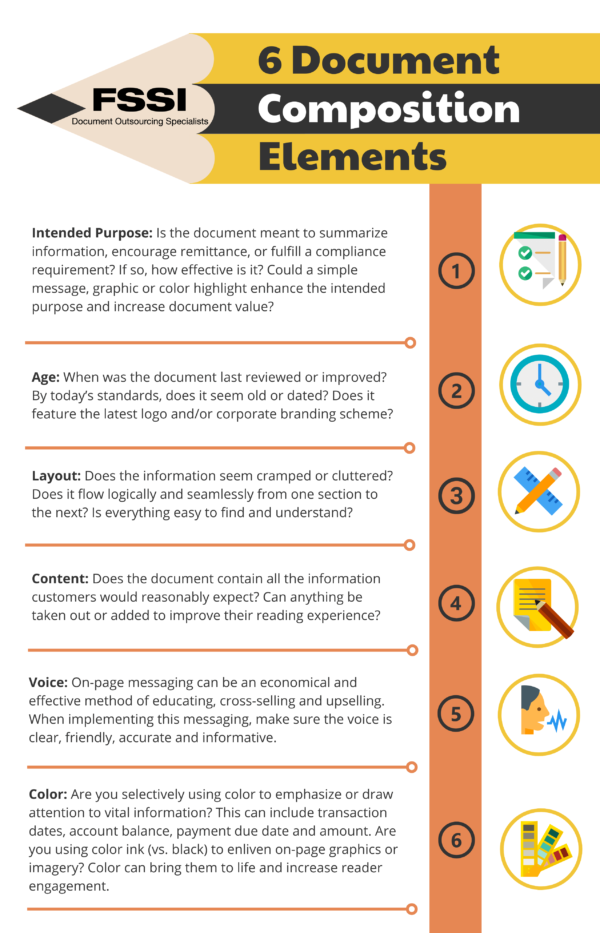
1. Purpose Clarity for Financial Documents
Every bank statement, credit union notice, or billing document serves a specific function. Define it clearly:
- Information summary and account activity
- Payment remittance and due date communication
- Compliance disclosure and regulatory requirements
- Cross-sell opportunities and product awareness
Match design to purpose. Highlight payment due dates with color. Use strategic placement for time-sensitive information. Graphics and selective color emphasis increase document effectiveness by 40% or more.
2. Document Freshness and Brand Consistency
When did you last update statement templates? Outdated designs signal outdated service.
Modern consumers—especially Gen Z and Millennials—judge financial institutions by visual presentation. Your documents should reflect current branding, logo updates, and contemporary design standards across all customer communication channels.
3. Information Architecture and Layout Flow
Cramped layouts reduce comprehension. Logical flow improves action rates.
Review your statement structure:
- Does information progress naturally from account summary to transaction details to payment instructions?
- Can customers locate key data (balance, due date, contact info) instantly?
- Does whitespace enhance readability or does text overwhelm the page?
Financial services documents with optimized layouts see 25-30% faster payment processing.
4. Content Optimization for Banking Communications
Include what customers expect. Remove what they don’t need.
Eliminate duplicate fields, redundant legal text, and repeated messages. Each inch of paper costs money. Make it count.
Add value through:
- On-page marketing messages for product education
- Personalized offers based on transaction history
- Timely announcements and service updates
- Clear calls-to-action for digital enrollment
5. Strategic Color Use in Financial Statements
Black-and-white documents get ignored. Color commands attention.
Our color specialists use variable color printing to emphasize critical information:
- Payment due dates in red or orange
- Account balances in bold blue
- Promotional messages in brand colors
- Transaction categories color-coded for clarity
Eyes naturally gravitate toward color. Use it strategically to guide customer focus and drive desired actions.
6. Voice and Messaging Consistency
If you include marketing copy on statements, make it count. Clear, friendly, accurate messaging builds trust.
Maintain consistent voice across all customer touchpoints—from paper statements to email notifications to online banking portals. Omnichannel marketing consistency creates seamless customer experiences that drive engagement and loyalty.
Proven Document Design Best Practices for Financial Services
Apply these time-tested principles to any customer-facing document:
- Maximize whitespace impact: Include necessary information without overwhelming readers. Whitespace improves retention by up to 20%
- Eliminate wasted real estate: Every square inch represents marketing value. Don’t repeat messages or waste premium space
- Simplify relentlessly: Remove duplicate fields and redundant text. Simple layouts leave room for revenue-generating calls-to-action
- Maintain cross-channel consistency: Mirror design elements across print, digital, and mobile platforms for recognition and ease of use
- Choose readable typography: Font selection affects comprehension more than most realize. Prioritize legibility over style
Business Benefits of Optimized Financial Documents
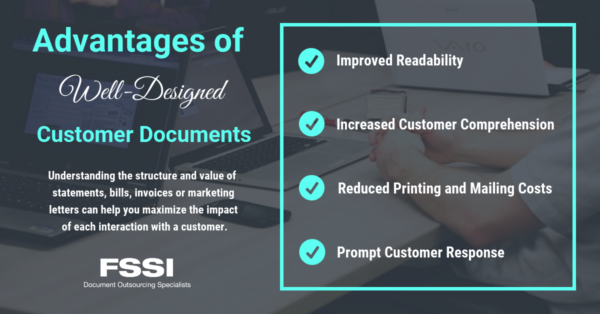
Well-designed bank statements and credit union communications deliver measurable results:
- They get opened and read (95%+ open rates vs. 20% for email)
- They communicate clearly without confusion or support calls
- They facilitate faster information processing and payment action
- They prompt responses to marketing messages and product offers
Monthly customer mailings represent a significant expense to businesses. Optimization maximizes ROI on every piece.
Combining Transactional Mail with Marketing Strategy
Most financial institutions miss opportunities by treating statements as separate from marketing campaigns.
Modern technologies enable integration:
- Variable data printing for personalized product recommendations
- Direct Mail 2.0 connecting physical mail to digital channels
- eStatement options with embedded marketing content
- SMS integration for payment reminders and offer notifications
Convergence of transactional and promotional messaging improves customer communication efficiency while reducing overall marketing spend.
The Competitive Advantage of Professional Document Design
First impressions matter. Outdated statement design signals outdated service—especially to younger customers.
Your monthly mailings shouldn’t look like they’re stuck in the 1980s. (Though some Gen Z nostalgia might argue otherwise.)
Each statement, bill, invoice, or compliance letter represents a valuable customer conversation. Small design improvements generate disproportionate returns in response rates, ROI, and customer engagement.
Clear Communication Framework for Banking Documents
Effective financial document design combines multiple disciplines:
- Plain language principles for regulatory compliance clarity
- Behavioral psychology for action-oriented layouts
- Professional graphic design for visual hierarchy and flow
- Usability testing for customer-validated improvements
- Context personalization using customer data and transaction history
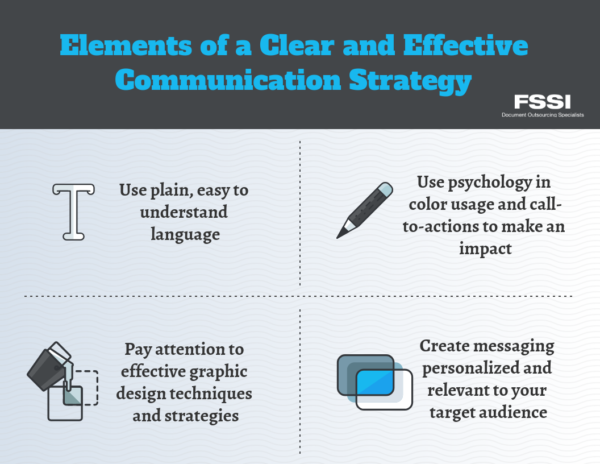
Integration of these elements transforms functional documents into strategic assets.
Visual Impact Matters: The Case for Color in Financial Statements
Eyes are drawn to color. Period.
We’re bombarded with information daily. Digital and physical noise surround us constantly. Color helps critical messages break through.
FSSI Color Specialists add variable color to black-and-white statements strategically. Important information “pops.” Payment due dates become immediately visible. Customers find what they need faster, then act faster.
When customers don’t have to scan entire documents for payment information, your DSO (days sales outstanding) drops measurably.
Document Design Best Practices
- Utilize white space: Include all the important information, but don’t overwhelm customers with too much text. White space helps customers better retain information.
- Don’t waste space: Every single inch of a customer document is valuable; don’t waste any space by repeating messages.
- Keep it simple: Simplify your messaging, remove duplicate fields, redundant text, and focus on your company’s target message. Keeping things simple leaves space to add marketing messages, coupons, announcements, and other calls to action.
- Maintain consistency: By keeping these elements consistent across all communication channels in the new omnichannel world we now live in gives your customers a seamless experience across all platforms, making it easy for them to quickly find the information they are looking for.
- Use a readable font: This seems simple enough, but many make the wrong choice.
Free Document Design Audit for Financial Institutions
Want an objective assessment of your current statements, bills, or customer communications?
FSSI Marketing Communications Specialists provide complimentary reviews including:
- Layout and information architecture analysis
- Color usage and whitespace optimization recommendations
- Copywriting and messaging effectiveness evaluation
- Before-and-after samples from similar financial institutions
Our in-house design team—including graphic designers, content writers, programmers, and color experts—works with banks, credit unions, auto finance companies, insurance providers, and other financial services organizations.
See real examples from our before-and-after archive. Review document transformations across multiple industries we serve.
Take Action on Your Statement Design Today
Balance matters in financial document design. You’re either maximizing document value or leaving money on the table.
Ready to take your customer communications to the next level? Contact FSSI at 714.436.3300 to discover how to extract maximum value from every customer touchpoint and increase ROI on your transactional documents.
For additional insights on extracting maximum value from every customer touchpoint, download our Document Value Checklist to discover new ways to increase ROI on transactional documents.