

Tax Form Printing and Mailing Services for Secure, Compliant High-Volume Delivery


Outsourced tax form printing and mailing services can become essential at the moment organizations have the least flexibility. High document volumes, fixed IRS deadlines, sensitive taxpayer information, and limited tolerance for error can strain internal teams and systems during peak season.
Common challenges include:
- Limited staffing and production capacity
- Greater potential for manual errors
- Data-security and compliance risks
- Reduced visibility into production and mail delivery
- Compressed timelines for correcting exceptions
FSSI provides secure, high-volume tax form printing, mailing and fulfillment services that help organizations manage these demands with greater control. From data intake and document formatting to printing, mailing, tracking and digital delivery, FSSI supports the full production lifecycle with auditable workflows.
Instead of reacting to tax season, your team can enter it with a more reliable plan for year-end tax form mailing.
Instead of reacting to tax season, your team can enter it with a more reliable plan.
Why Tax Form Processing Requires Secure, Compliant Workflows

For financial institutions, government agencies, healthcare organizations, and other high-volume mailers, tax form processing is more than a print-and-mail project. It is a deadline-driven operational function involving compliance, customer communications, data security and accurate delivery.
Tax documents may contain personally identifiable information, account details and other sensitive data. They must meet applicable formatting, distribution, and filing requirements. At high volumes, a small issue in data, document setup or production can lead to delays, reprints, returned mail, increased customer-service activity or potential compliance exposure.
A reliable tax document printing and mailing program should address:
- IRS formatting and distribution requirements
- Protection of personally identifiable information throughout production
- Fixed recipient-delivery deadlines
- Accuracy across large and changing data files
- Production reporting, reconciliation, and mailstream visibility
FSSI helps organizations manage these requirements through defined procedures from secure file intake through final delivery.
Tax Forms and Documents FSSI Can Process
Organizations often need support for more than one year-end tax document type. A centralized processing workflow can help reduce complexity when multiple forms, notices and recipient communications must be produced on a compressed schedule.
FSSI supports high-volume tax form printing and mailing for documents such as:
- 1099 printing and mailing and related recipient communications
- W-2 printing and mailing
- Taxpayer notices
- Corrected tax documents
- Year-end statements
- Government and regulatory mailings
- Other time-sensitive, data-driven tax communications
By bringing document production, mailing, tracking and return-mail handling into one workflow, organizations can reduce the number of vendors, handoffs, and internal processes required during tax season.
Secure Tax Form Processing Infrastructure and Compliance Controls

Production capacity matters, but capacity alone does not prevent errors, protect data or ensure consistent outcomes. The real differentiator in secure tax form printing and mailing is process control.
FSSI maintains SSAE 18 Type II certification and aligns with SOC 2 + HITRUST CSF standards, supporting secure data handling, system availability, and confidentiality. These controls are supported by documented procedures, regular audits and operational safeguards across data processing, print production and fulfillment.
Data Mapping and Output Validation
Tax data may originate from multiple departments, platforms or source systems. Without a structured intake process, inconsistent file formats can create manual work, document-formatting issues and production delays.
FSSI uses data mapping and file normalization to convert source files into approved document formats before production begins. This reduces manual handling and supports consistency across 1099 forms, W-2 forms, and other tax documents.
A qualified tax form fulfillment partner should provide:
- Audited controls for print, data handling, and fulfillment
- Security and confidentiality practices aligned with recognized standards
- Documented data-ingestion and file-normalization procedures
- Output validation before production
- Defined processes for exceptions and production changes
These controls help make accuracy repeatable at scale instead of being dependent on last-minute reviews.
End-to-End Tax Form Processing Tracking and Visibility
One challenge with in-house tax form operations is the lack of visibility after a file enters production. Teams may know a job was submitted, but they may not have a clear view of its production status, completion or mailstream progress.
FSSI helps close that gap with job tracking and production reporting from intake through print and insertion. Teams can monitor progress throughout the workflow rather than waiting for an issue to surface after a deadline is already at risk.
Piece-Level Tracking and Mailstream Visibility
Unique Piece Tracking provides greater accountability during production by helping confirm that individual documents are processed as intended. Once mail enters the USPS network, Intelligent Mail Barcode integration can provide continued visibility into mailstream activity.
This level of tracking helps organizations:
- Monitor production status more closely
- Confirm completion and reconciliation activity
- Improve internal reporting
- Identify potential delivery issues earlier
- Reduce uncertainty during high-volume tax mailing periods
Automated Workflows That Support Accuracy
Accuracy at scale should not depend solely on a final quality check. It should be built into the workflow from the beginning.
FSSI applies automated data validation before production begins, helping verify that files meet formatting and processing requirements upfront. Secure PDF proofing gives teams an opportunity to review and approve document layouts digitally while maintaining an auditable approval record.
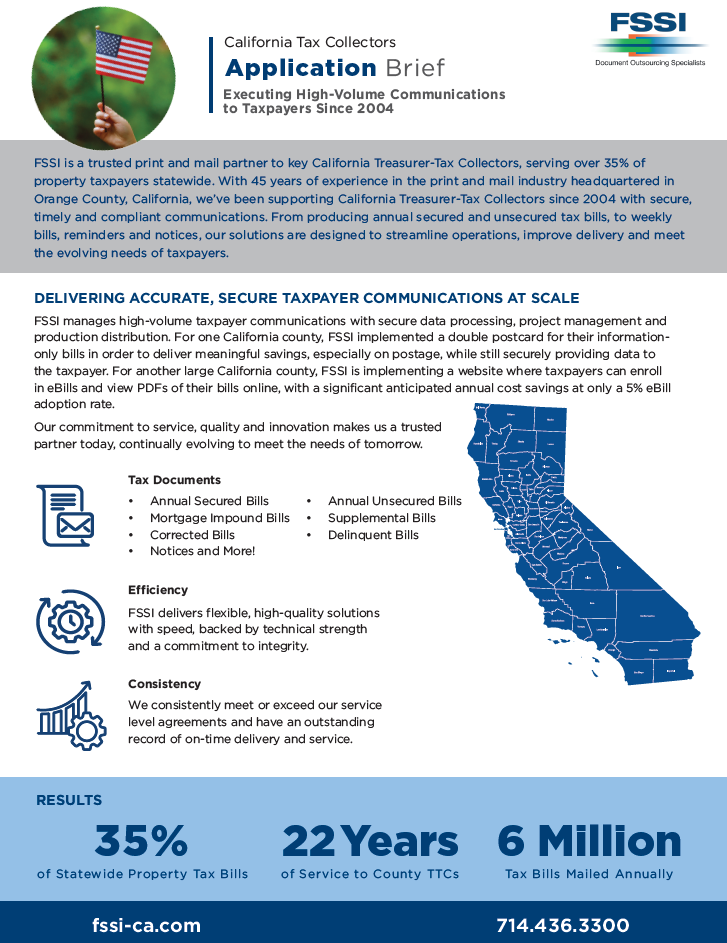
Read our Application Brief about our work with California Tax Collectors
Closed-Loop Reconciliation and Data Protection
During production, closed-loop reconciliation helps confirm that every processed piece matches the source data file. This reduces the risk that documents are missing, duplicated, or incorrectly matched during high-volume runs.
Additional production safeguards can include:
- Secure file-transfer and data-handling procedures
- Digital proofing and approval workflows
- Automated validation before print production
- Closed-loop reconciliation
- Full-sheet formatting where appropriate
- SSN masking to reduce exposure through envelope windows
The goal is not only to produce tax documents quickly. It is to create a controlled process that supports accuracy, confidentiality and accountability at every stage.
Print and Digital Tax Form Delivery Options
Physical mail remains essential for many tax communications, but recipients increasingly expect convenient digital access as well. Organizations may need to provide required printed documents while offering eligible communications through secure electronic channels.
FSSI supports hybrid delivery models that can include print, mail, electronic presentment, and mobile access. This approach can improve accessibility without requiring organizations to manage separate workflows or vendors for physical and digital communications.
Lowering Processing and Mailing Costs
The value of outsourcing extends beyond reducing pressure on internal equipment and staffing. Cost control also comes from improving the efficiency of each step in the document and mail workflow.
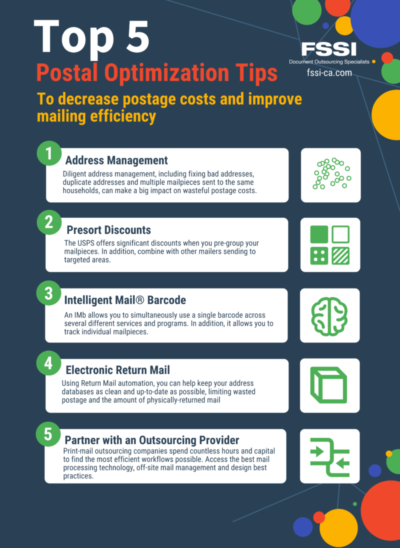
FSSI can incorporate address-quality, postage-optimization and returned-mail processes into tax form production.
NCOA Processing and Address Accuracy
NCOA processing helps improve address quality before mail enters production. Identifying address changes early can help reduce undeliverable mail, unnecessary postage and recipient-service issues.
Householding and Postage Optimization
When appropriate, householding can combine multiple documents going to the same address into one envelope. This can reduce envelope usage, material cost and postage while simplifying the recipient experience.
Automated Return Mail Management
Returned tax documents can create significant manual work for internal teams. FSSI’s eReturn Mail service digitizes and automates return-mail handling, helping organizations identify returned pieces, update records and reduce the burden of manual review.
These process-level efficiencies can reduce waste, improve data quality and lower total operational costs over time.
What to Expect from a Modern Tax Form Processing Partner
Not all tax form processing providers offer the same level of control, security, visibility or flexibility. A strong tax form mailing services partner should be able to support the entire workflow, not just print documents after receiving a finished file.
Look for a provider that offers:
- Secure tax form printing and mailing capabilities
- Flexible data intake from multiple file formats and systems
- Data mapping, normalization, and output validation
- Secure PDF proofing and documented approvals
- Real-time job tracking and production reporting
- Piece-level tracking and Intelligent Mail Barcode visibility
- NCOA processing and address-quality services
- Return-mail management
- Print and digital delivery options
- One-off production flexibility without requiring a full recurring program
- Documented security and compliance controls
The right provider should make tax season easier to manage while giving your team greater confidence in the process.
Tax Form Onboarding and Implementation
Moving tax form processing to an outsourced partner should not introduce new risk. A structured implementation process helps ensure that document layouts, data fields, timing, approvals and reporting expectations are defined before peak production begins.
A typical tax form onboarding process may include:
- Reviewing source files and document requirements
- Mapping data fields to approved document templates
- Validating output formats and document logic
- Completing secure PDF proofs and approvals
- Establishing production schedules and delivery expectations
- Testing workflows before high-volume production begins
- Defining reporting, reconciliation, and escalation procedures
Early planning creates time to identify exceptions, resolve data issues and confirm that all stakeholders are aligned before IRS deadlines approach.
Scale Tax Form Processing for Peak Season Demand
Seasonal volume spikes are one of the most difficult parts of tax form processing. Internal teams often respond with temporary staffing, extended work hours, added equipment demands or compressed review cycles.
FSSI is structured to help absorb volume variability without forcing organizations to redesign their internal operations. Production capacity, staffing, workflows and tracking processes are designed for high-volume output and time-sensitive document delivery. That stability allows internal teams to stay focused on oversight, compliance, exception management and strategic planning rather than day-to-day production execution.

Plan Earlier for a More Predictable Tax Season
Plan tax form processing well before year-end. Early preparation allows time to validate data, approve formats and proofs, test workflows, set schedules and resolve issues before deadlines tighten.
If tax season feels like controlled chaos, the issue may extend beyond staffing or volume. It may signal a gap in process or infrastructure.
FSSI provides secure, high-volume tax form processing for organizations that cannot risk delays, errors or added compliance exposure. From 1099s and W-2s to taxpayer notices, digital delivery and government mailings, we manage each stage through auditable workflows, so your team can focus on oversight and strategy.
Preparing for the next tax cycle? Call FSSI at 714.436.3300 or contact us online to review your workflow, identify gaps, and build a more reliable process.